Sewage materials
Urban wastewater and rainwater can settle in the sewage system. The materials or sediments that settle are mainly composed of waste and a mixture of organic matter and sand, with proportions that vary greatly depending on the nature of the system.
Sewage sludge, also known as ‘sewers material’, comes from cleaning various types of collectors: rainwater networks, wastewater networks or combined networks.
Their physico-chemical characteristics vary depending on:
- the type of structure cleaned (depending on its hydraulic characteristics),
- the type of effluent (wastewater, rainwater or mixed water),
- and the type of environment (urban or rural).
What treatment for sewage sludge?
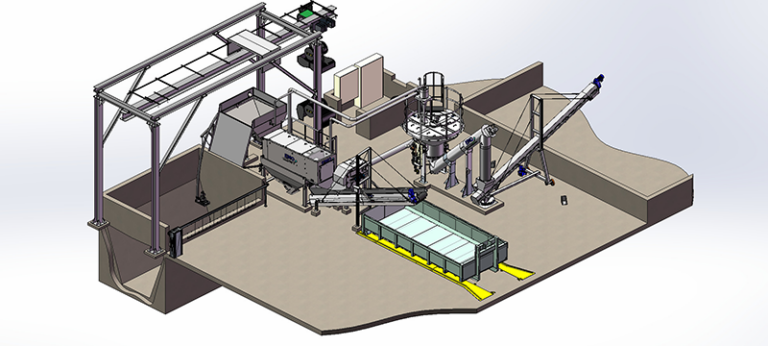
EMO offers fully automated solutions for liquid/solid separation during the pre-treatment phase of hydrocleaning trucks, as part of sewer cleaning and street sweeping campaigns.
The main stages of the installation provided by EMO are as follows:
- reception in a pit,
- pickup by grab,
- screening
- mechanical washing to a greater or lesser extent depending on the characteristics of the products to be treated,
- sand washing,
- storage/disposal of cleaned sand.
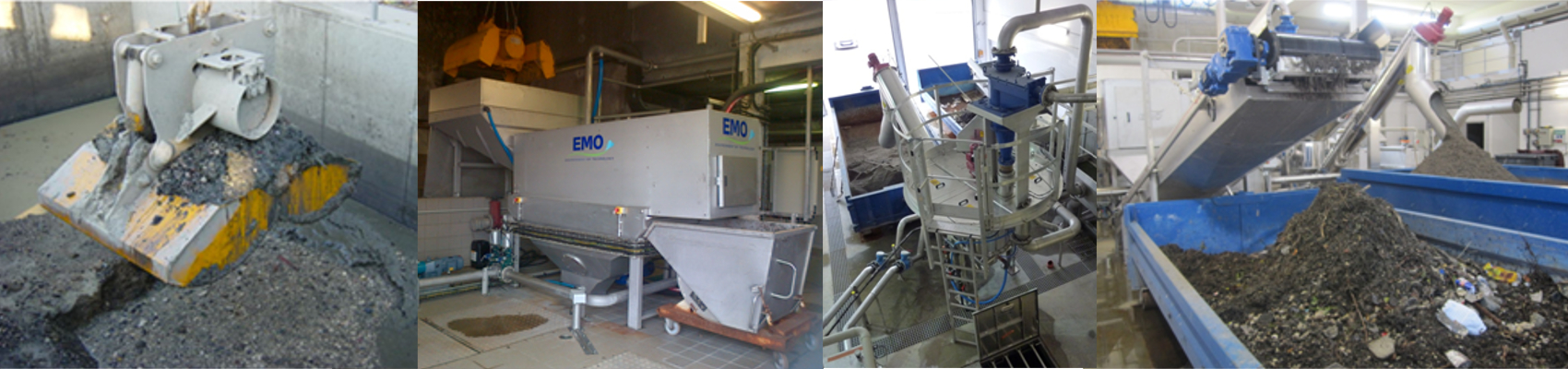
Recovery by grab
Sewage materials are generally collected by hydrocleaning trucks and sucked directly from manhole covers. They are then transported to a treatment plant where they are poured into a concrete pit to be picked up by a grab.
Trommel screening
The product is then conveyed in a controlled flow to the rotary trommel for screening.
The materials fed into the trommel are separated into two categories:
- Those larger than 10 mm, also known as ‘bulky waste’, are conveyed inside the perforated tube, washed by two spray ramps and removed at the tube outlet by the internal spiral. They are disposed of directly into a tank or by a belt conveyor.
- Those smaller than 10 mm pass through the perforations in the perforated tube and fall into a tank to be collected by a transfer pump..
Sand treatment
Fine materials (OM + sand) are collected by a pump along with the wash water from the trommel and transferred to the sand washer, which separates and extracts organic matter and sand.
The latter are squeezed out and evacuated using a transfer screw. The washwater, which contains fine organic particles, can be filtered before being discharged into the conventional wastewater treatment system. These pieces of equipment are adapted to each other according to the required treatment flow rate.
The treatment of sewers materials by EMO

EMO offers you an equipment suited to each stage of treatment: from transfer to separation and final disposal. Discover our complete range of sand washers, classifiers and conveyors to manage your sewers materials and more with confidence.
Are you looking for more information about our range of equipment?