Treatment of sludge from wastewater treatment plant
Sludge from wastewater treatment plant is treated to reduce its volume and facilitate its removal and/or recycling.
From the thickening of the sludge to the conveying process, through conditioning, dewatering and stabilization stages, EMO determines the equipment that will meet your needs: gravity belt thickeners, belt filter presses, plate filter presses, screw presses, flocculators, belt/screw conveyors or screw compactors…
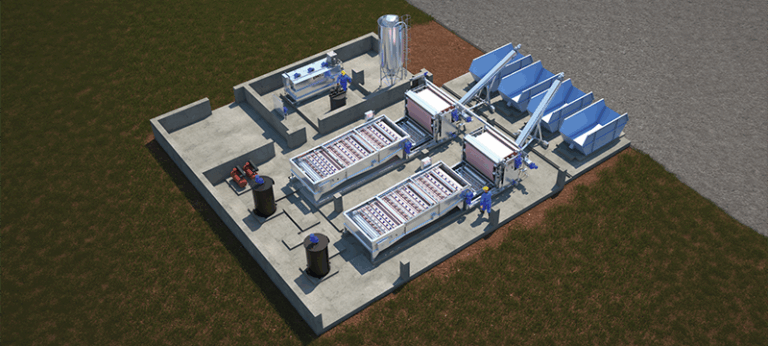
Different solutions
-
Thickening
Thickening does not involve adding a thickening agent and thickening the sludge, but rather removing some of the water, to obtain a less liquid sludge.
EMO has developed a complete range of equipment specially designed for the dynamic and continuous thickening of sludge, whether urban or industrial. Whatever the size of the installation, from small to very large capacities, there is one range that will suit.
-
Digestion
The thickened sludge is then sent to anaerobic digesters, where it is broken down by bacteria in an oxygen-free environment. This process produces biogas, which can be used as an energy source.
-
Dewatering
Mechanical dewatering of sludge on belt filter presses, centrifuges or screw presses is generally accompanied by prior sludge conditioning with the addition of polymer to ensure satisfactory separation of water and matter. The volume of sludge can be reduced considerably,
EMO has developed a wide range of belt filter presses and combined units, including gravity belt thickeners and belt filter presses. These units combine the thickening and dewatering processes, meeting current environmental concerns regarding energy consumption and operation.
-
Sludge drying
This is an important step in sludge treatment: it aims to further reduce the water content of dewatered sludge, making it easier to handle, transport and dispose of.
After an in-depth analysis of the three drying solutions — direct, indirect and mixed — EMO has selected the direct technology for its superior energy efficiency, technical robustness and ease of operation. A system with a low energy footprint, dust free and capable of achieving up to 90% dryness.